Wednesday, October 04, 2006

On Walking Alone


Walking
Originally uploaded by plasticrevolver.
Every morning around 7am a friend and I walk a vigorous three miles. We've been doing this for almost two years, holding each other accountable for maintaining the discipline of a daily exercise regimen.

Having not worked out with any regularity during the years when my daily schedule was less flexible, I now tend to approach this with a measure of self-righteousness. However, I generally choose not to reveal that my walking partner is eighteen years my senior and has had hip replacement surgery. On occasion he has walked our route with the help of a cane. Admitting this tends to diminish the image of manly fitness my hubris demands.

The friendship with my walking partner spans over 35 years and includes personal, family, church, and professional relationships. The hour we walk each day includes conversation about our fairly compatible political views, the state of our families, the miscues of our local sports teams, and sometimes some deeply personal issues. His sense of humor spawns stories that would evoke groans in any audience. I'm sufficiently used to it that I respond with the shake of my head and a brief prayer petitioning deliverance. Once or twice a week we develop strategies for saving the earth, creating world peace, or getting the Royals to the World Series.

Sometimes, like this week, he is out of town and I have to walk alone. I do so at a nearby public exercise track, replacing my friend with a strap-on radio/CD player. I know it's not much, but at least it hasn't had a hip replacement. Usually I listen to NPR's morning show, unless there is some burning issue being discussed by one of the city's two 24 hour sports stations.

I can't deny that an hour of NPR has a higher intellectual and cultural content than an hour of Dick and me. That might even be true of the sports talk show, except listening to it tends to make me want to scratch my crotch and spit. That is generally not well-received by the senior citizens who constitute most of the walkers on that track at that time of morning.

But here's the problem. I keep wanting to interrupt the NPR hosts and guests so as to correct or comment upon things they say. My radio/CD player is not interactive. No matter how loudly I speak they just move forward without benefit of my viewpoint. This severely diminishes the marketplace of ideas. With Dick there is an audience of one, at least as long as I'm walking on the side of his good ear.

One other thing I've noticed is that the hour seems longer when walking alone. The give and take of conversation causes the familiar surroundings to pass by more quickly. Sharing that slice of each day with a treasured friend is a gift. It's not the topic of discussion but the bond of friendship that transforms a workout into a sacrament.

So hurry home, Dick. See you Saturday morning at 7am or thereabouts.

And you know that one about the three walruses who went into a bar? I've heard it.

Seven times!

Technorati tags:

Tuesday, October 03, 2006

Baseball History and the Nation's Soul

Today opens the Major League Baseball playoffs, a sporting event that is under-appreciated by those of us who pass through life as Kansas City Royals fans. Our team accomplished another 100 loss season and was out of contention somewhere around Easter. We did have an impact on the playoffs, however. By sweeping the last three games of the season with Detroit we knocked the Tigers out of first place, relegating them to wild card status, with its attendant loss of home field advantage and other perks. Hey, at least we got noticed for something other than having fly balls bounce off the forehead of our outfielder.

So how do the baseball gremlins show their gratitude for our contribution? Those wins mean that our 100 losses were not the worst in baseball this year, an honor we had been working hard to achieve. But darned if Tampa Bay didn't go out and lose 101 and for that accomplishment they get the number one draft choice--likely to be a stud catcher who is seen as a "can't miss" prospect. So by winning we still lose, and now the Royals have to settle for contributing to a slice of baseball history. At least that's something to be puffed up about.

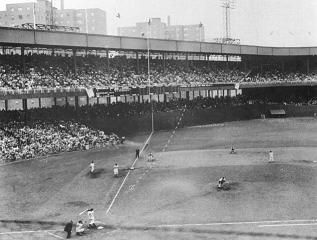
However, I had barely been given the opportunity to smirk about all of that before hearing a story on NPR this morning that took a little of the luster off historical smuggery. The story was a fine piece about what some call the greatest game ever played. It was the first nationally televised sporting event, occurring on October 3, 1951, exactly 45 years ago today. Many celebrities were in attendance and had a big emotional investment in the game, which ended when Bobby Thomson of the New York Giants belted a dramatic walk-off home run in the bottom of the ninth to beat the Brooklyn Dodgers 5-4, thereby winning the National League Pennant. The story became one of the most treasured in baseball lore. Pundits called it "the shot heard round the world."

Now comes NPR with its balloon popping story. Here's the link, well-worth a listen, but the gist of it is that the Giants were apparently stealing signs by placing a guy with a telescope out behind the center field fence so as to see what pitch is being called. He then transmitted that via a set of signals to the bench and ultimately to the batter.

The bottom line is that Bobby Thomson knew what pitch was coming when he hit "the shot heard round the world." Apparently some rumors of this have been around for years. But no one wanted to report it. No one wanted to diminish the story, which had become such an icon of baseball folklore. Thomson kept quiet about it, the opposing pitcher likewise. It is said the deception took its toll on the participants, who paid an emotional price for having to embrace the story, dishonesty and all.

It seems we need our mythic tales to remind us that life has its serendipitous magical moments. In general, I tend to feel that cultures need strong foundations of truth on which to build. When we suspend disbelief we risk losing perspective and making grievous errors that undermine and threaten the national soul. Witness the Iraq war as the most compelling example in our time.

But sometimes perhaps we can allow ourselves a wink and a nod and just go on as if the stories woven into our culture had no revisionists out there to besmirch them with the unwelcome truth. Bobby Thomson still had to hit the pitch he knew was coming, didn't he?

And the Royals? Well, we only need this small historical achievement for a few months. Once spring training starts all of our myths will be in the future, not the past.

Technorati tags:


Photograph of Bobby Thomson home run is used in accordance with fair use standards. Copyright information can be found here.


Sunday, October 01, 2006

On Mowing a Straight Line


Mow, mow, mow your lawn...
Originally uploaded by bcostin.
I mowed my lawn this weekend. I've mowed this yard hundreds of times over almost 20 years. I know the contours of the lawn, where the tree roots push up into the grass, where some rock outcroppings lay just below the surface, and where the run-offs from hard rains have trenched ruts into the soil. I have a mowing pattern that I always use, cross-cutting in certain places and otherwise following the familiar path that seems most efficient. It's all mapped out in my head. I do it the way I always do it.

It gets pretty hot in Missouri during the summer and in July and August you have to decide whether to water extensively or let the grass go dormant. I compromised, keeping the front yard fairly green and letting the back yard go. It's a pretty sad sight out there--splotchy brown spots everywhere, grass shoots spindly and sickly, and some areas that may never bounce back without seeding.

All of that is bad enough, but what really gets me is what happens to my mowing pattern. In these conditions there are a lot of places that don't need mowing at all. It is silly to follow the pattern because you would be pushing the mower over dead grass. But then it gets to be a jumble. In some places the grass is so frail that you easily lose track of the line you cut on the previous pass. As a result you find yourself zig-zagging all over the place, then back-tracking when it looks like you missed some spots.

The mower ran out of gas. I started with a full tank and it never runs out. But this time the tank was empty before I finished, which means that I covered more ground cutting less grass. And at these gas prices no less. (Thankfully there is an election in a few weeks so the prices are dropping a bit so as to elect more Republicans. I can't imagine how disgusted I would have been had this happened when the prices were at full oil company gouging rates like they were a few weeks ago.)

All I know is this. I had a path that I always follow and when the state of the lawn did not allow me to follow it I wandered as if in the wilderness, unable to mow a straight and efficient line, doubling back on myself without realizing it, and even leaving myself unsure that I had got it all.

I thought of a story I had heard about a white missionary who found himself lost in an African jungle. He finally stumbled into a village, explained his plight, and asked for help getting where he needed to go. A tribesman agreed and led him into the jungle, using his machete to hack away at the thick brush. After a while the missionary, unable to discern where they were heading, began to quiz his guide. "Where are we going; where is the path?," he demanded to know. The guide responded, "Bwana, in this jungle there is no path. I am the path."

Sometimes life doesn't conform to the paths and maps with which we try to chart our way. The straight line may not always be the best way to journey between two points, or even if it is the best way it may not be feasible. Sometimes we have to look around and seek navigational help from places we never would have imagined. Sometimes that is deep within ourselves.

Staying on the straight and narrow is good advice I guess, even for mowing. But when scorching Missouri summers do in my yard my familiar Briggs and Stratton mower and I need to travel a different route. It makes me restless, feels aimless, doesn't seem right somehow. But maybe a little wandering in the wilderness is okay now and then. Keeps us humble, and hopefully nimble. There will be times when we discover that the paths we've come to count on may not always be there.

But the lawn still has to be mowed.

Saturday, September 23, 2006

Barry Goldwater and the "Good Old Days" of Political Discourse

I was never a fan of Barry Goldwater, although I found his blunt way of talking rather refreshing. He was the virtual embodiment of conservatism in the middle years of the 20th century. His book, The Conscience of a Conservative, was the bible of conservative thought in the 1960's.

Lyndon Johnson, elevated to office by the assassination of President Kennedy, trounced Goldwater in the 1964 campaign for the Presidency. I was a high school student at the time and mostly remember Goldwater as the guy who was going to lead us into nuclear war because of his "extremism." I remember the famous quote in his acceptance speech at the Republican Convention:

"I would remind you that extremism in the defense of liberty is no vice! And let me remind you also that moderation in the pursuit of justice is no virtue."

He took a huge amount of heat for that one, although I have to admit that the quote actually makes a valid point. Goldwater generated a lot of fears at a time when people were building fallout shelters in their backyards. I remember the short-lived television commercial depicting a little girl innocently pulling petals off a flower as a mushroom cloud explodes in the background.

Now comes an interesting HBO documentary, Mr. Conservative: Goldwater on Goldwater. Produced by his granddaughter, it is a sympathetic depiction of the man, but it also has some important insights into politics then and now. Let me mention two.

The first is the capacity of politicians 40 years ago to mightily disagree with one another in Congressional deliberations and then to go out together, have a drink or dinner, and talk about life and family. There are many examples of this--Hubert Humphrey, Tip O'Neill, Lyndon Johnson. Barry Goldwater was another.

According to the documentary, Goldwater was a good friend of John F. Kennedy. It became apparent at some point that the two of them might very well be running for office on their party tickets. They talked about how they would campaign and apparently agreed to travel the country on the same plane, disembarking to discuss their vast differences on public policy issues, then climbing aboard together as friends enroute to their next stop.

Such a thing would never happen today, and we are the poorer for it. The politics of personal attacks, dirty tricks, and polarization are what we have in place of the spirited but respectful dialogue of another time. Oh them good old days!

The other thing learned from the film is that labels don't fit. Many of Goldwater's positions would be comfortably embraced by today's social liberalism. He had a gay grandson who he supported without qualification. He was appalled by those who tried to insert religious agendas into public policy.

The film is well worth a look. It helps us put perspective on today's political machinations and demagoguery. How we long for a climate where men and women of goodwill are allowed to speak their minds and unburden their hearts without fear that their lives will be stripped bare in the tabloids. The politics of personal destruction distorts and mutes the political discourse this nation needs.

I'm glad Barry Goldwater did not become president. But I am also glad that he brought his ideas into public life and participated in the vigorous but respectful dialogue that our world has a right to expect from those who would lead us.

Technorati tags:

Friday, September 22, 2006

God and Politics: An Unholy Alliance?

There is hope these days for those of us who have been dismayed by the efforts of conservative Christians to inject their theological and cultural agenda into party platforms and political campaigns. The bumper sticker sentiment that "God is neither Republican nor Democrat" has seemingly been lost within the fundamentalist/evangelical churches. The tendency is to demonize Christians who do not share their social agenda. The constitutional separation of church and state is increasingly ignored by right wing ideologues who see those churches as providing foot soldiers for partisan conservative causes. The horror stories are endless.

The problem is exacerbated by Democrats and other liberals who seem tone deaf when it comes to understanding the language and perspectives of people of faith who do not embrace the conservative social agenda. John Kerry was like a deer staring into headlights when asked questions about his Catholic faith. Candidate after candidate just chose to cede the religious ground, apparently feeling that progressive politics could not be found in the pew. Wrong, wrong, wrong!

They took a thrashing in 2004, failing to defeat a vulnerable president and electing weak congressional candidates who should have been booted out of Congress so they had more time to pack for the Rapture. But the licking they took had some positive outcomes. Finally, at long last, some liberals got religion. It was a new kind of deathbed repentence.

They realized that they needed to find authentic voices of faith who could help frame the political agenda in a way that spoke to the hearts and souls of church folks. They had forgotten that civil rights, support for the poor, economic justice, and a vast array of social reforms had been birthed in the churches. Now it seemed that the only "Christian voice" came from the right--people who had unbending positions on abortion, homosexuality, and school prayer, with nothing to be said for poverty, equality, and peace. The progressive Christian voice needed a microphone, and someone who could speak sensibly into it.

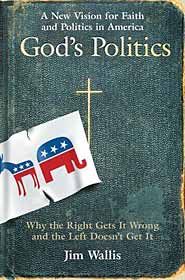
One who emerged was Jim Wallis, an evangelical Christian with social justice burned into his bones. Jim is the founder of Sojourners, an important journal of faith and justice, and of Call to Renewal, an interfaith effort to end poverty in the United States. I have been privileged to work with him in several different arenas over the past few years. I rejoice in seeing how his eloquent voice is now being heard across the land. His book, God's Politics: Why the Right Gets It Wrong and the Left Doesn't Get It, has become a best seller. It is essential reading for Christians with a social conscience.

Now comes word this week that a blog has been created as a way of extending this important dialogue. Bookmark this site (God's Politics: A Blog by Jim Wallis and Friends) and join in the conversation.

I have written previously about how I awoke after election day 2004 with a seething anger over the role played by churches in that election. Where were the prophetic voices? Where was the demand for justice?

I'm beginning to hear the voices, still muted and often overcome by the strident rhetoric of the right. But I am hearing the whisper of hope. Listen for it, point to the places where you hear it. Add your whisper. Let it become a mighty rushing wind.

Technorati tags: